Showing posts with label 1. Bezirk: Innere Stadt. Show all posts

14 September 2010

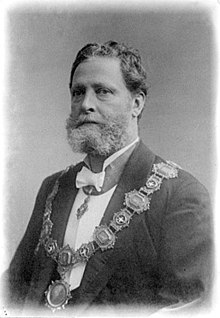
Who Was Karl Leuger?


As one drives along the most monument filled area of the Ringstrasse, one may notice that part of the famous street as well as two statues remember Karl Leuger.

As opposed to the extremes of others of the time, Karl Leuger, was a more pragmatic “Schwarz-gelb,” a believer in Austria with populist ideals at the turn of the century. An opportunist, Leuger changed to the democratic camp and used anti-Semitism to promote Vienna’s native son to higher offices. He quickly broke with anti-Semitic extremism of Schönerer to create the Christian Socialist Party, centered on the interest of “little men” and “Greater Austria.” However, he did continue to support the Germanic supremesist, Guido von List.

His time in office as mayor of Vienna (1897 to 1910) was highlighted by improvements in city living: construction of public buildings; development of the tramway systems; the Wiener Hochquellwasserleitung, which still brings fresh water from nearby the mountains; and the creation of a greenbelt of meadows and forests around the city.

However, Leuger’s policies slid in to dictatorship as the people worshiped their new hero, leaving a legacy that is said to have led the way to Austro-Fascism and even Hitler's reign of terror.

As one hymn sung his praises:
Let us praise the hero, who leads us in the fight.
Joyfully show him praise and thanks which are his due.
Let us also raise our hands in prayer,
May God make us victorious, wherever his banner flies.

08 September 2009

Facts about 1. Bezirk


The above seal symbol of Vienna and the first district, or as it's called: The Innere Stadt (Center City). This dates back to circa 1270.

Area: 2.88 km²

Population: (as of 2005) 17,289 - the least populated district in Vienna
At it's highest, there were 73,000 people in this small neighborhood

Prestige: "For lots of them, an office in the prestigious first district is necessary to have for the letterheads. Speaking of prestige: The first district has a population of a mere 17,000, with a high percentage of foreigners. Yet Viennese consider an address from the first district to be equivalent with an academic degree or a noble name." - from tourmycountry.com

Religion: (as of 2001) 51.3 %: Roman Catholic, 6.6 % Protestants, 5.1 % Orthodox Christians, 3.3 % Jews, 22.7 % non-confessional

Top Tourist Locations:
* Albertina (palace converted to art museum)
* Burgtheater (produces plays)
* Graben (main shopping street)
* Hofburg Imperial Palace (Imperial seat of the Hapsburgs)
* Kapuzinergruft (The Imperial Crypt)
* Kärntner Straße (main shopping street)
* Kunsthistorisches Museum (historical art museum)
* Maria am Gestade Kirche (church)
* Peterskirche (church)
* Ruprechtskirche (church)
* Schottenstift ("Scottish Abbey", a monastery)
* Stephansdom (St. Stephan's Cathedral)
* Das Rathaus (Vienna's city hall)
* Pestsäule (a plague column)
* Virgilkapelle (underground chapel in Stephansdom U-bahn station)
* Wiener Staatsoper (Vienna State Opera House)
* Stadtpark (City Park)
* Jesuitenkirche (Jesuit or University Church)


Größere Kartenansicht

26 August 2009

Erste Bezirk


So, let's start at the very beginning. I could create a whole blog about nothing but the first district, so I'm sure I will return again and again to places I love in this area.

A little Geography:
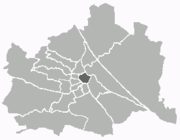
Erste Bezirk, or Innere Stadt, borders on Leopoldstadt in the northeast, on Landstraße in the east, on Wieden and Mariahilf in the south, on Neubau and Josefstadt in the west, and on Alsergrund in the north. The district border are marked by Urania, Wienfluss, Lothringerstraße, Karlsplatz, Gedreidemarkt, Museumsplatz, Museumstraße, Auerspergstraße, Landesgerichtsstraße, Universitätsstraße, Maria-Theresien-Straße and the Donaukanal.


Of course, it's the oldest part of the city and has tons of old churches with dead Hapsburgs (the old ruling family) and palaces and museums. There is also great shopping and even better coffeehouses, Konditorei (confectioners), and Eis Salons (gelaterias).

This a very tourist friendly area, but in the off season I would not call it touristy in all areas. There are so many little Gassen (alleys) and archways that actually go through buildings, you do not have to feel like you always in a crowd. And the city is safe enough that you can feel free to explore. I mean, keep in mind this is a city so don't be foolish - but the side streets a surprising little jewels of interest to discover.


This is a little clock shop that is tucked into the eaves of a church.


A friend showing the delights of a Konditorei.


Window display at a textile shop


For more information check out Wikipedia and TourMyCountry.com